


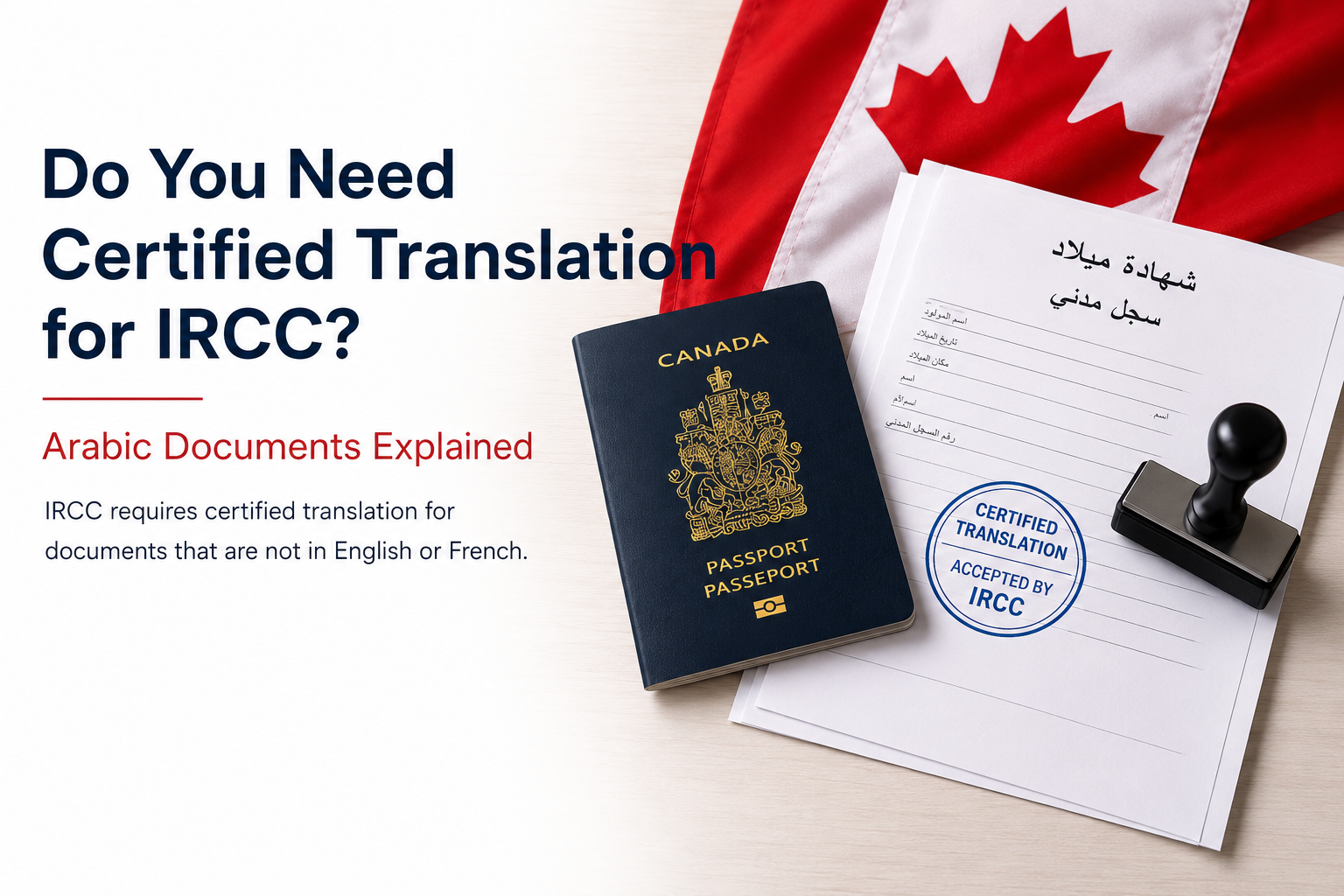
If you are applying for Canadian immigration through Immigration, Refugees and Citizenship Canada (IRCC) and your documents are in Arabic, one of the most important requirements you must meet is providing accurate certified translations.
Many applicants ask whether certified translation is truly mandatory for immigration applications. The short answer is yes—in most cases, certified translation is required whenever your supporting documents are not written in English or French, Canada’s two official languages.
Failing to submit properly translated documents can lead to delays, additional requests from immigration officers, or even refusal of your application. Understanding when certified translation is required can save time, money, and unnecessary stress during your immigration journey.
What Is Certified Translation?
A certified translation is an official translation completed by a qualified professional translator who confirms that the translated document is accurate and complete.
For immigration purposes, certified translations often include:
- A complete and accurate translation of the original Arabic document
- The translator’s certification statement
- The translator’s signature and credentials
- In some cases, notarization or affidavit requirements depending on jurisdiction
This certification gives immigration authorities confidence that your submitted documents accurately reflect the original information.
When Does IRCC Require Certified Translation?
IRCC requires certified translation whenever documents submitted with your application are not in English or French.
This requirement applies when:
1. The Document Is Written Entirely in Arabic
If your document is issued only in Arabic, it must be translated before submission.
Examples include:
- Birth certificates
- Marriage certificates
- Divorce records
- National identification documents
- Divorce certificates
2. The Document Is an Official Government Record
Government-issued legal or civil status records must be translated by a certified professional.
These often include:
- Civil registry extracts
- Police clearance certificates
- Court judgments
- Residency certificates
3. The Document Supports Immigration Eligibility
Any document used to prove eligibility for your immigration application must be understandable to IRCC officers.
This includes evidence related to:
- Education
- Employment history
- Family sponsorship
- Financial documentation
What Happens If You Don’t Provide Certified Translation?
Submitting untranslated or improperly translated Arabic documents can create serious problems for your immigration application.
Application Delays
IRCC may place your file on hold and request corrected translations, which can significantly extend processing times.
Returned Applications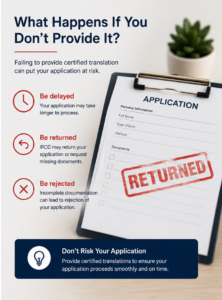
Incomplete applications may be returned before processing even begins.
Requests for Additional Documentation
Immigration officers may issue a formal request asking for certified versions of your translated documents.
Application Refusal
If key documents cannot be properly verified, your application could be rejected.
This can result in:
- Lost processing time
- Additional application fees
- Delays in immigration plans
Common Arabic Documents That Require Certified Translation
Applicants from Arabic-speaking countries frequently need certified translation for the following documents:
Family and Civil Status Documents
- Birth certificates
- Marriage certificates
- Divorce decrees
- Family registration books
- Death certificates
Educational Documents
- Diplomas
- Academic transcripts
- Degree certificates
- Professional certifications
Employment Documents
- Employment verification letters
- Salary certificates
- Work contracts
- Experience letters
Legal Documents
- Court decisions
- Police clearance certificates
- Affidavits
- Custody documents
Immigration and Identity Documents
- Passports (when supporting pages contain Arabic text)
- National identity cards
- Residence permits
- Military service records
Why Professional Translation Matters
Immigration documentation must meet strict standards. Even minor translation errors can raise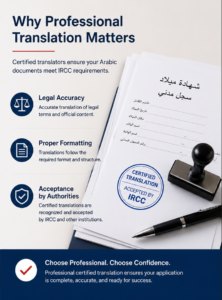 concerns during review.
Professional certified translators ensure:
Legal Accuracy
Immigration officers rely on precise terminology. A mistranslation can alter the legal meaning of a document.
Proper Formatting
Certified translators preserve:
- Official seals
- Stamps
- Signatures
- Document structure
This helps IRCC verify authenticity.
Completeness
Nothing is omitted, summarized, or paraphrased.
Every detail—including handwritten notes, stamps, and annotations—is translated where necessary.
Compliance With Immigration Standards
Experienced certified translators understand IRCC documentation requirements and prepare translations accordingly.
Why Arabic Documents Require Special Attention
Arabic legal and civil documents often contain:
- Regional legal terminology
- Official government phrasing
- Handwritten annotations
- Specialized formatting conventions
A translator without experience in Arabic immigration documentation may miss critical details.
That is why choosing a professional with expertise in Arabic certified translation is essential for Canadian immigration applications.
How to Choose the Right Certified Translation Provider
When selecting a translation provider, look for:
- Certified professional translators
- Experience with IRCC immigration documents
- Fast turnaround times
- Clear certification statements
- Accuracy guarantees
Avoid low-cost automated translation services, as these are rarely accepted for immigration purposes.
How Transarabic Can Help
Navigating immigration document requirements can be overwhelming, especially when dealing with Arabic legal and official records. This is where Transarabic can simplify the process.
We specialize in certified Arabic-to-English and Arabic-to-French translations designed specifically for immigration applications submitted to Immigration, Refugees and Citizenship Canada (IRCC).
Certified Translation You Can Trust
Our professional translators are experienced in handling sensitive immigration documentation, ensuring every translation is:
- Accurate and complete
- Properly formatted
- Professionally certified
- Prepared to meet immigration submission requirements
Expertise in Arabic Official Documents
We regularly translate a wide range of Arabic documents, including:
- Birth and marriage certificates
- Family registration records
- Academic diplomas and transcripts
- Employment verification letters
- Police clearance certificates
- Court and legal records
Our familiarity with Arabic legal terminology and regional document formats helps ensure nothing is overlooked.
Fast Turnaround for Time-Sensitive Applications
Immigration deadlines can be strict. Transarabic offers efficient turnaround times so your application stays on schedule.
Quality Assurance for Peace of Mind
Every document undergoes careful review to ensure:
- Translation accuracy
- Consistency of terminology
- Compliance with certification standards
- Clear and professional presentation
Personalized Support
Our team understands that every immigration application is unique. We provide guidance throughout the translation process, helping you submit your documents with confidence.
Whether you are applying for permanent residency, family sponsorship, study permits, or work permits, Transarabic is here to help make your immigration journey smoother and more successful.